
East Anglia TWO cable ducts set world record, says ScottishPower
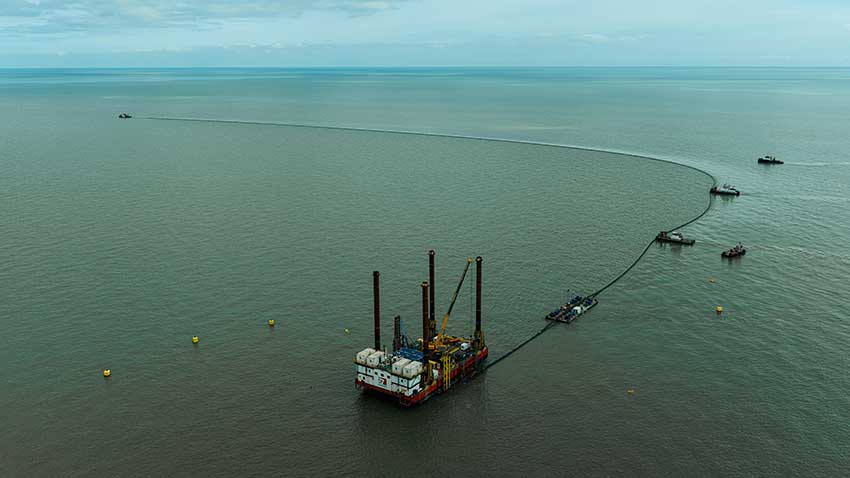
ScottishPower Renewables has completed the installation of two cable ducts beneath the Suffolk coastline and seabed for its £4bn East Anglia TWO offshore windfarm, in what the company describes as a global engineering first. Each duct is just under 1,800 metres long and 800mm in diameter.
The ducts will provide a protected route for the high-voltage export cables that will carry electricity from the 960MW windfarm to shore. ScottishPower Renewables said they are the world’s longest continuous single sections of extruded polyethylene duct, and that the combination of length and diameter makes this the largest electricity transmission landfall of its kind in the UK.
The company compared the length to Edinburgh’s Royal Mile, from the castle to Holyrood Palace, or the stretch of the Thames between the London Eye and Tate Modern.
How the ducts were installed
The ducts were installed using horizontal directional drilling (HDD), which creates a bore deep underground rather than digging up beaches, dunes, cliffs or coastal habitats. ScottishPower Renewables said the work was carried out with rigs operating onshore and offshore at the same time.
According to ScottishPower Renewables’ local project updates, drilling at the landfall site north of Thorpeness was scheduled to begin from 13 July, with crews working 24 hours a day because of the continuous nature of the process.
Ross Ovens, managing director for offshore at ScottishPower Renewables, said: “The completion of this colossal HDD, which is three times the length of our other East Anglia projects, is a huge achievement, quite literally, and a major milestone as we progress construction of our third windfarm in the region.”
He said landfall works are known to be among the most technically challenging parts of building an offshore windfarm, and credited planning by principal contractor OCU Group and duct manufacturer Pipelife.
The HDD works form part of the East Anglia TWO civil engineering programme being carried out by OCU Group, with support from its subsidiary Peter McCormack & Sons. ScottishPower Renewables said the contract is supporting more than 80 jobs during construction.
Mike McNulty, HDD director at OCU Group, said: “Successfully installing the first 1,800-metre, 800mm diameter PE pipe in a single continuous section is testament to the skill and commitment of everyone involved.”
Pipe made and towed from Norway
The pipe was manufactured by Pipelife at its facility in Stathelle, Norway. Martin Myhre, project manager at Pipelife Norway, said that at 1,793 metres it was the longest pipe the business had ever produced.
He said continuous extrusion allowed the pipe to be made as one uninterrupted length without welding. “This eliminates welded joints, resulting in a more robust and reliable solution for this demanding application,” he said. The finished pipe was then transported from Norway to Thorpeness by tow.
ScottishPower Renewables expects the first of the windfarm’s export cables to be installed in summer 2027, with commercial operation targeted for late 2028.
East Anglia TWO will be located in the southern North Sea, about 33km from the Suffolk coast at its nearest point off Southwold and 37km from Lowestoft. The company said it will be able to power the equivalent of almost one million homes, and that the project has so far put more than £1.5bn into the UK supply chain.
The windfarm is the company’s third in the region. Its 714MW East Anglia ONE has been operating since 2020, according to ScottishPower Renewables.
The construction timetable comes as the government pursues a target of at least 43 gigawatts of offshore wind capacity by 2030. In January, Tom Glover, RWE’s UK chief executive, said it was unrealistic to expect all five of the group’s newly contracted projects to be generating by that deadline.
The shift of projects from leasing into construction has also shown up at the Crown Estate, which manages the seabed. In June it reported that its return to the Treasury had fallen to £487m as offshore wind option fees faded, down from £1.1bn a year earlier.


